

The hesitation is almost always the same. You spot a hand-block printed textile or a carved wooden wall piece and you love it — genuinely love it — and then a small voice says: but will it just look like I'm trying too hard? That fear of the "theme party home" keeps a lot of beautiful, meaningful objects from ever making it off the product page.
Here's the thing: that fear is mostly about proportion and context, not the objects themselves. Indian artisan décor has been influencing global interiors for centuries — the trick isn't avoiding it, it's knowing where to let a piece breathe and where to hold back.
Start With One Anchor, Not a Collection
The theme-party look happens when every surface in a room is doing the same cultural work at the same volume. The fix is simple: choose one anchor piece per room and let everything else support it quietly.
An anchor piece is something with visual weight — a hand-block printed cotton throw draped over a sofa, a chakra-style wall hanging centered above a console, or a carved wooden frame around a mirror. It earns attention. Everything around it — the neutral cushions, the plain lamp, the empty wall space — gives it room to be interesting without competition.
If you're just starting out, pick one room and one piece. See how it settles in over a week. You'll almost always find it needs less company than you thought.
Room by Room: Where Each Piece Actually Works
The Entryway
This is genuinely the best place to introduce Indian artisan décor into a Western home, and it's underused. A toran — the traditional hanging decoration placed above a doorway — works beautifully above an interior entryway arch or mounted along a console table as a horizontal runner. It signals warmth and intention the moment someone steps inside, without committing an entire room to a look.
Keep the rest of the entryway spare: a plain mirror, a simple hook rail, maybe a basket for shoes. The toran does the talking.
The Living Room
This is where people overthink it most. They want the hand-block printed cushion covers, the woven throw, and the wall art — all at once. The result feels busy rather than layered.
Pick one textile direction. If you go with printed cushion covers in indigo or terracotta, keep the throw solid. If the throw is the patterned piece, the cushions can be textured but plain. Indian artisan textiles tend to have strong visual personalities — they're designed to be the focal point, not the background.
Wall art works well in living rooms when it's given real estate. A single traditional Indian wall piece hung on an otherwise empty wall — especially in a hallway that opens into the living space — reads as considered and confident, not cluttered.
The Dining Table
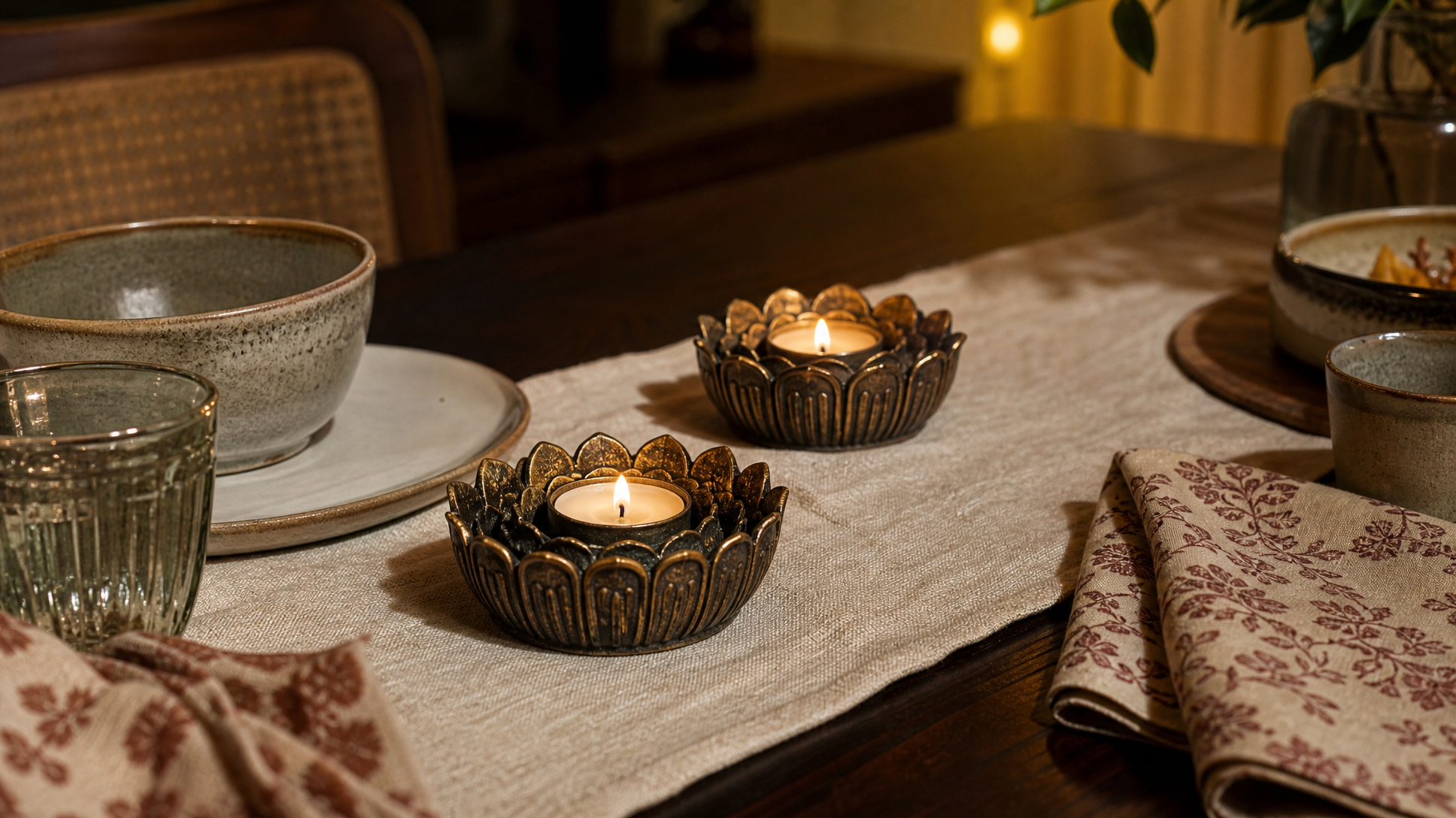
This is where handcrafted Indian pieces shine most naturally in a modern Western home, because the dining table is already a curated, intentional space. Lotus-shaped tealight holders or hand-crafted candle holders placed at the center of a table do exactly what a good tablescape needs: they create warmth, they invite conversation, and they look like a choice rather than an accident.
Pair them with plain linen napkins and simple ceramic plates. The contrast between the ornate handcrafted piece and the understated tableware is what makes both look intentional.
The Bedroom
Restraint matters most here. One hand-block printed cotton cushion on a neutral bed, or a single piece of traditional wall art above a bedside table — that's usually enough. The bedroom is a room people want to feel calm in, and Indian artisan textiles in particular can carry a lot of visual energy. One piece, placed deliberately, lands as serene. Three pieces fight each other.
The Color Question Everyone Gets Wrong
People assume Indian artisan décor means jewel tones and bold contrast. Some of it does. But a significant part of India's craft tradition — particularly block-printed textiles from Rajasthan and Gujarat — works in earthy, muted palettes: ochre, slate blue, rust, natural off-white. These tones sit very comfortably inside a Scandinavian-influenced or neutral modern interior without any awkward negotiation.
If you're nervous about color, start there. A hand-block printed piece in natural dyes often integrates more easily than you'd expect, because the palette is already doing the work of grounding it.
What to Avoid
Matching sets. If every cushion cover, throw, and wall piece comes from the same pattern family, the room stops feeling curated and starts feeling like a catalog page. Mix craft traditions — a block-printed textile with a carved wooden piece, for example — and the result feels collected rather than coordinated.
Also: resist the urge to explain the pieces to your décor. You don't need a room full of context to justify one beautiful object. It doesn't need to be surrounded by other Indian pieces to make sense. It just needs space.
The Easiest Starting Point
If you want one low-commitment way to test this out: start with a handcrafted candle holder or a small decorative piece for a shelf or side table. Something that takes up a square foot of space and costs you nothing in terms of commitment to a larger look. Live with it. See what it does to the room's feeling. That's usually all it takes to understand that this kind of décor isn't about transformation — it's about depth.
When you're ready to go further, browse the Home Décor collection — it's a good place to find pieces that work as anchors without overwhelming a room, including hand-block printed textiles, artisan candle holders, and traditional wall art sourced directly from Indian craftspeople.
Frequently Asked Questions
Can Indian artisan décor work in a minimalist or Scandinavian-style home?
Yes — and often surprisingly well. The key is choosing pieces with quieter palettes (natural dyes, earthy tones) and giving them plenty of negative space. A single hand-block printed textile or a carved wooden piece against a plain white wall can feel very much at home in a minimal interior; the craft texture adds warmth without visual noise.
How many Indian décor pieces are too many in one room?
There's no hard number, but a useful rule of thumb is one anchor piece per room with supporting accents that don't compete for attention. When every surface is doing cultural work at the same volume, the room starts to feel like a theme. When one piece leads and the rest of the room stays quieter, it feels intentional.
What's the difference between handcrafted Indian décor and mass-produced Indian-style décor?
Handcrafted pieces are made by individual artisans using traditional techniques — hand-block printing, hand-carving, hand-weaving — which means slight variations in pattern, color, and texture are part of the object, not a defect. Mass-produced Indian-style décor replicates the aesthetic but loses the irregularity and craft history that give the originals their character. If you look closely, you can usually tell: handcrafted pieces have a warmth and slight imperfection that machine-made pieces don't.
Is Indian artisan décor appropriate as a gift for someone with a non-Indian background?
Absolutely. Handcrafted objects with cultural depth make more meaningful gifts than generic décor precisely because they carry a story. The key is choosing something with broad aesthetic appeal — a beautifully printed textile, a carved wooden piece, or an elegant candle holder — rather than something so specific in its symbolism that it needs explaining. The craft speaks for itself.